A Critical Summary of The Weight of Glory, C.S. Lewis
The Weight of Glory, is the title of a book, but it is really just a short message that C.S Lewis gave, which was later put onto paper. The book contains this message along with a handful of other letters and messages by C.S. Lewis.
In The Weight of Glory, Lewis deals with the concept of glory as laid out in the Bible. Pulling from imagery given in the Bible, he delves into what it means to have the glory which God promises to us.
It is my aim to break down this short message to convey the simple, yet beautiful truth which Lewis gives us here.
Are Rewards a part of Christian Doctrine?
Lewis starts off by giving us a juxtaposition about virtues.
If you asked twenty good men today what they thought the highest of the virtues, nineteen of them would reply, Unselfishness. But if you had asked almost any of the great Christians of old, he would have replied, Love. (p25)
He goes on to say that this reflects a shift in the minds of people today. We are more consumed with abstinence than with the blessing of others. That forgoing our own pleasure is the focus of life. Lewis is challenging us to think deeply about that. Does Christ call us to abstain from all pleasure and reward, or is this shift of asceticism ungodly?
Christ does in fact call us to deny our selves and pick up our cross to follow Him (Matthew 16:24). But Lewis says that there is more to this.
... and nearly every description of what we shall ultimately find if we do so contains an appeal to desire. (p26)
If we read the next verse from Matthew 16 we see Jesus saying that we will gain life and much more if we deny our self and follow Him. Just as Lewis says, we find an appeal to desire, not a command of self-denial as an end unto its self.
Lewis takes this a step further by saying that we do not have a problem of wanting too much, but of wanting too little. The answer here is not to abstain of all things, but to look higher, to look at God.
We are half-hearted creatures, fooling about with drink and sex and ambition when infinite joy is offered us, like an ignorant child who wants to go on making mud pies in a slum because he cannot imagine what is meant by the offer of a holiday at the sea. We are far too easily pleased. (p26)
Three Kinds of Rewards
He goes on to talk about the three kinds of rewards that exist. They are as follows:
- The natural outcome of an action, marriage as the outcome of love.
- The barbaric outcome of an action, money as the outcome of love.
- The unknown, longed-for outcome of an action.
The first two are self-explanatory, but the third is the important one here. It is when you have a longing or desire in you that can only be fully known and fulfilled when you have gone through an action or series of actions.
That was quite wordy, so C.S. Lewis explains it with an analogy. Imagine a Greek language student who goes through pain to learn Greek for school, but on the back end of it is able to experience the joy of Greek poetry. They did not know what that joy would be like; they may have been told, but could not experience it firsthand. However, they endured to the end and can now fully experience a new kind of reward, Greek poetry.
Lewis points out as well that this student might have been enjoying English poetry before learning Greek, and that the student really had a longing for the more enjoyable Greek poetry. However, this longing can only be fulfilled once the Greek language has been mastered.
So this kind of reward is twofold, (1) There is a longing in you for something which you may or may not know about. (2) That longing can only be fulfilled upon completing the actions required to illuminate the longing and enable you to fulfill it.
Longing for Christ
Just as the student enjoys English poetry before the Greek poetry ever comes into the picture, we have a longing and desire for Heaven before Heaven is ever even hinted to us. Our English poetry, as Lewis says, is a secret in us which we label nostalgia, longing, desire, or romanticism; that thing which you, "cannot hide and cannot tell, though we desire to do both." (p30)
We think we have resolved this secret, our English poetry, by labeling it with these names and feeling their feelings, but here Lewis calls us to go deeper.
These things–the beauty, the memory of our past–are good images of what we really desire; but if they are mistaken for the thing itself, they turn into dumb idols, breaking the hearts of their worshipers.
Lewis says that this nostalgia is not just that; it is the door to the delayed, longed-for reward. All we must do is learn Greek, to use the former analogy. We must go deeper and discover what's on the other side.
The other side, we find, is the center of what it means to find meaning and joy. To act as if that small voice in you, which tugs on your heart, is simply nostalgia or the good ol' days is a pitfall that leads to pain. Rather, they are the signpost, the road, the hand that God guides us to the real place where we can find true fulfillment and reward.
The issue here is that this secret never truly points to anything in this world. It may seem like it with its memories of the past, longing for more time with that loved one, or to hear that song from high school that you love so much. However, these things are all a part of a greater category; they all tug at the deeper longing in you for something higher than this world.
There is another analogy Lewis makes here that is helpful to tie up this point. Being hungry does not mean we will get food, but it does mean we are of the kind who requires food and live in a world where food exists. Or, put another way, it would be odd if we had the idea of romantic love in a sexless world.
Just the same as these, it's a good indication that our longing, this secret that we have, shows that there is something to fulfill it, Heaven, and that some will attain it.
The Five Promises of Christianity
What then is this fulfillment of our longing, this Heaven? Firstly, all descriptions we can give are merely symbols. Some are Biblical and carry authority but because Heaven is outside of us it is by definition unknowable to us directly, therefor it can only be described symbolically.
There are five promises that Lewis gives to describe Christianity and Heaven.
- We will be with Christ.
- We will be like God.
- We will have 'glory'.
- We will be fed or feasted or entertained.
- We will have some official position in the universe.
Lewis asks a question here, why do we need any other promise than the first one? His answer is quite simply that you don't, but the others will be filled in whether we explicitly say them or not. Each of us has our own idea of what Heaven will be like, and each idea is only a symbol of what it will really be. So to keep us from bringing in unbiblical ideas, God gives us more symbols than just the first.
And finally after much discussion about rewards, longing, and promises we get to the heart of the message, Glory. What is it, and what do we do with it? These are the questions that will be answered going forward.
To review what has already been discussed, we have established that God does offer rewards to us, and they are quite central to the Christian claim. We have shown that humanity is made for Heaven and we each long for it. And we have established a few promises or symbols of what Heaven will be.
What is Glory?
Glory as Recognition
C.S. Lewis puts forward two kinds of Glory to examine. The first is glory as recognition. This is the kind of glory which most would point to first if they thought of it. Where someone pats you on the back and lifts you up for a deed you have done or for some other reason. In our case, it is God patting us on the back and saying, "Well done, good and faithful servant." (Matthew 25:23)
This is one half of the glory which we bear, and an important half as well. For, "How God thinks of us is not only more important, but infinitely more important." (p38) You see it is not by your own power, doing, or even thoughts of God that saves you. It is God's view of you alone that has real power, infinite power.
This makes glory as recognition one of the central tenants of the Christian faith, the tenant of divine grace. For we know we are evil in the sight of God but through Christs' blood, death, burial, and resurrection God now is able to look on us and say, "Well done good and faithful servant."
One more important point on glory as recognition. Lewis describes that at first, this might seem like an evil kind of glory. It might seem competitive, as fame and recognition tends to be. However, when we dig deeper into scripture, we find that it is not this way with God. God's love and knowledge is not limited. He can fully love and know each and every one of us without taking from someone else.
This glory is the fulfillment of our longing. It is the reward to our searching. It is being known by God and knowing God, thus fulfilling what is generally put forward as human's two basic needs: to be fully known and fully loved.
However, if there is fully known and fully loved, then there must be the opposite. Painfully, this is a reality that our Lord puts to us clearly by saying, "Depart from me, I never knew you." (Matthew 7:23)
Apparently, then, our lifelong nostalgia, our longing to be reunited with something in the universe from which we now feel cut off, to be on the inside of some door which we have always seen from the outside, is no mere neurotic fancy, but the truest index of our real situation. And to be at last summoned inside would be both glory and honour beyond all our merits and also the healing of that old ache. (p42)
Glory as Radiance
The second half of glory is radiance. We are to shine like the sun and stars in the Kingdom of God. (Matthew 13:43 & Daniel 12:3) This is the imagery that C.S. Lewis is pulling from to explain glory as radiance.
When human souls have become as perfect in voluntary obedience as the inanimate creation is in its lifeless obedience, then they will put on its glory, or rather that greater glory which Nature is only the first sketch (p43)
Nature, as beautiful and wondrous as it is, is only the first sketch of the glory which we will bear. We are made in His image, and a part of this means we are made to bear the glory of God that nature reflects. And one day, when heaven and earth pass, and we are united fully with our Lord, we will fully bear that glory in all its radiance. Being completely one with God, fully known and fully loved.
Lewis warns us that this kind of glory is not implying some kind of mystical idea of becoming one with nature. It only uses nature as a picture or symbol, as scripture invites us to do. God is the source and center of this glory, not us or nature. He imparts this glory in all His creation, and we have the great privilege to live in it and bear it.
The Weight of Glory
Now to the namesake of this message. We know what this glory is, now to discover what the weight that it holds. These last two pages of the message are, in my opinion, some of the most beautiful writing ever to put paper. If anything, I highly recommend picking up the book to read just page 45-46.
Lewis answers the question of, "now what" that follows any good string of logic or exposition. Now we must come to terms with the fact that everyone we meet is made to bear the glory of God. That each of them is working towards hearing one thing or another, "well done" or "depart from me". Not only do we bear this glory ourselves, but the weight of the glory in others. We help each and every person towards one of these two ends.
This of course is from the eyes of humanity and not the eternal all-knowing eyes of God who controls winds and seas. Ultimately, it is God who calls, but it is us who are the hands and feet that God uses to do so. How weighty and lofty a role it is to play. We would do well to maintain our unending prayers and supplication with God to not miss a moment of His divine plan. For, as Lewis says, it is only the humble which can bear this weight.
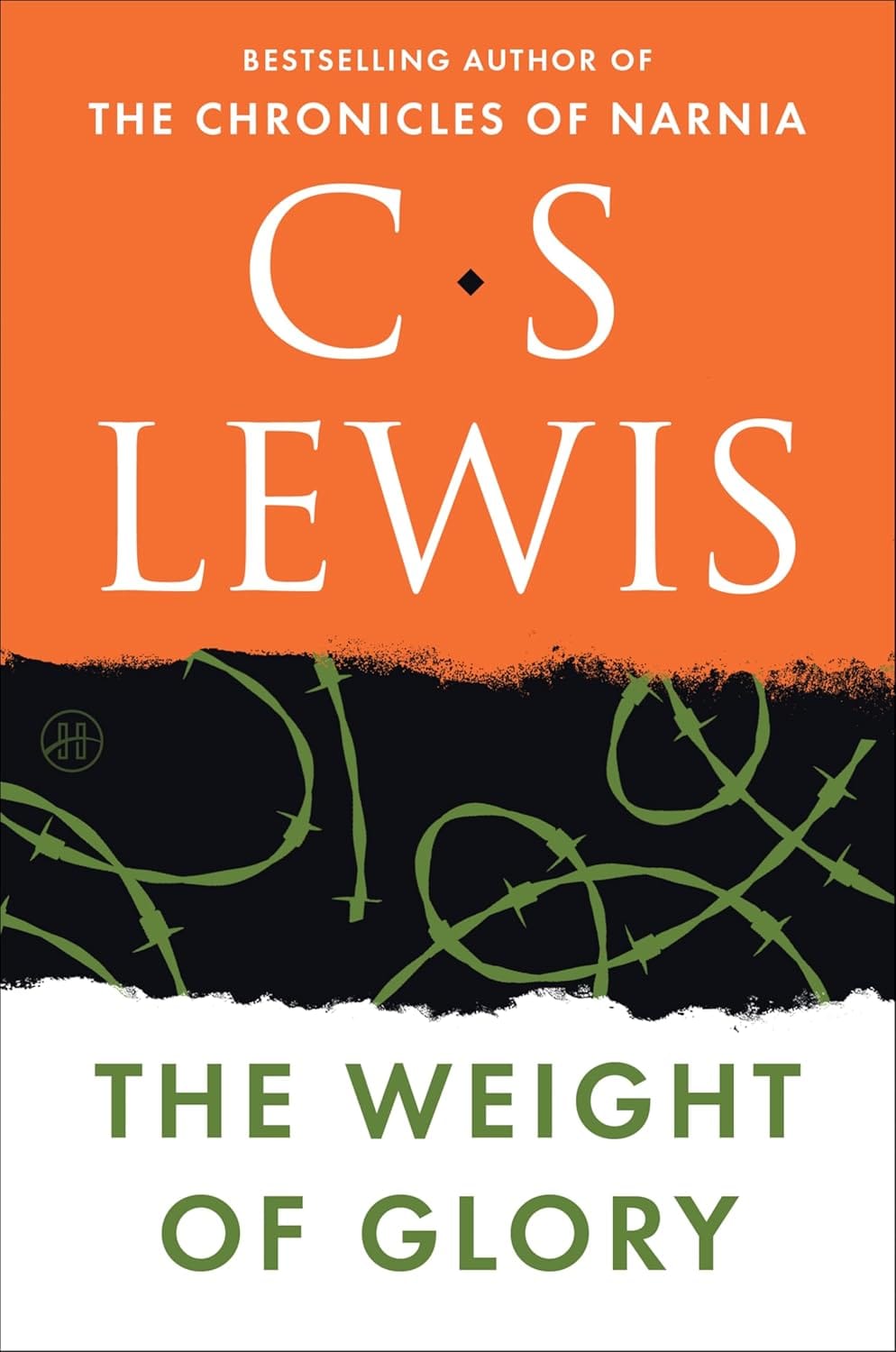
Here's the Amazon link to the copy I have. I am not sponsored or an affiliate, just want to provide the resources to this amazing work by C.S. Lewis.
Member discussion